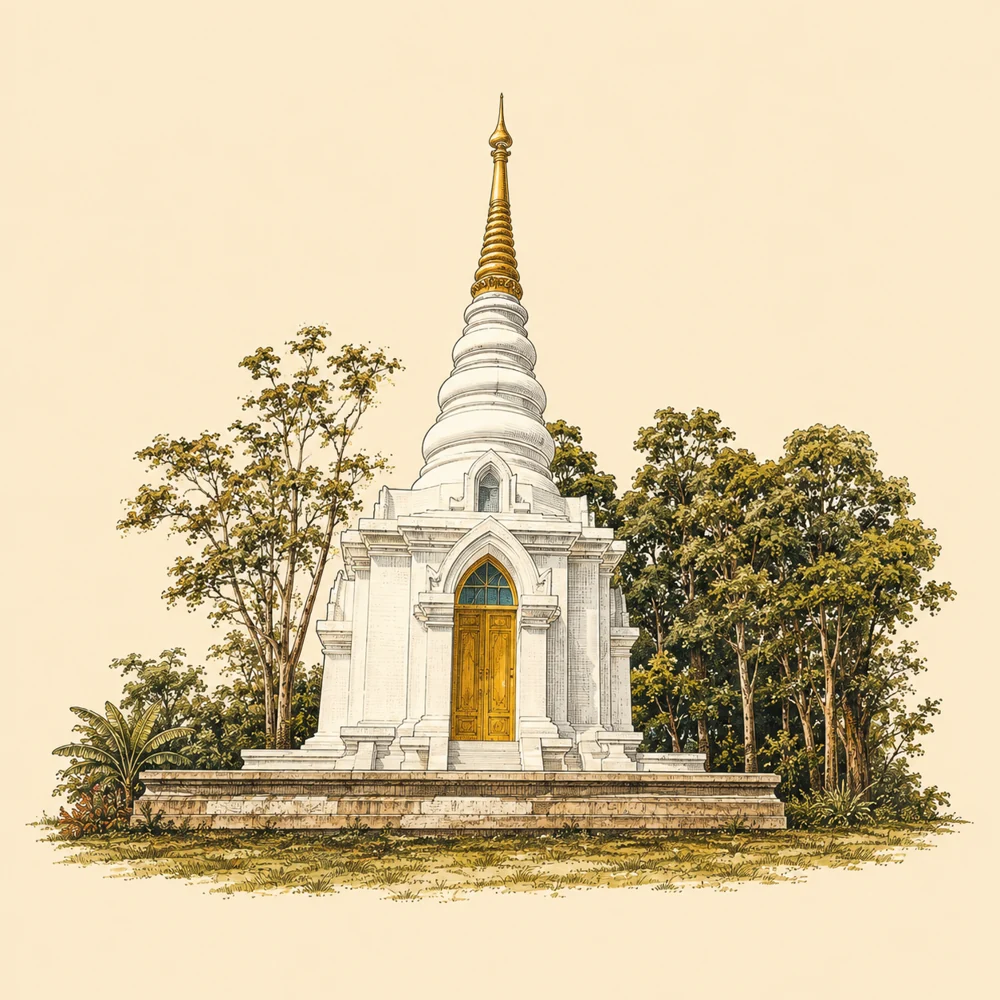
ThenFrom a forest monks' retreat to a town's sanctuary
About 200 years ago; temple registered in 1893 (2436 BE)
VerifiedEvidence from the Samnakngan Noyobai Lae Phaen Sapphayakon Thammachat Lae Singwaetlom (Office of Natural Resources and Environmental Policy and Planning) states that the beginning of Wat Khiri Khet was a residence for forest monks used for ascetical practices, and it was about 200 years old when the database was created. Thus, a more exact year of construction should not yet be concluded. The name "Wat Lum" used by villagers reflects the low-lying terrain of the temple in the old market area.
Another set of local information sources states that the temple was built or registered on 15 May 1893 (2436 BE) and later used the name Wat Phra That Khiri Khet under the Maha Nikaya sect. Inside, there is an ancient pagoda base with a large banyan tree growing on the base, and there are Buddha relics serving as a center of faith.
In the picture of Takua Pa town during the tin mining and maritime trade era, the temple was located near the old market and the community where Hokkien Chinese and groups of miners came to settle. However, verifiable sources do not state whether this temple was built by a town ruler or any specific person, and no direct evidence connecting the builder to any Chinese group has been found. Therefore, it can be told cautiously that the temple served as a religious site and a spiritual anchor for the old town community, rather than guessing its founder.
BeforeAn old temple tied to the memories of the old town
1919·2020 (2462·2563 BE); years of some events are still unknown
VerifiedA verifiable milestone is that the temple received the royal granting of the land for the consecration boundary on 25 August 1919 (2462 BE), showing that the temple had stepped from a former practice area to a temple with a clear ecclesiastical status. Meanwhile, the community still called the temple "Wat Lum" or "Wat Talat Tai".
Along the way, the replica of the Buddha's footprint, built by laywoman Kui Limsakun and the Takua Pa Buddhist congregation, was once enshrined on Khao Phra Bat before being moved to be kept at Wat Senanut Rangsan, and then moved to be enshrined in the ordination hall of Wat Phra That Khiri Khet according to local data. This also made the temple serve as a keeper of the town's symbols of faith.
Municipal documents during 2020 (2563 BE) recorded that the temple had an ancient ordination hall alongside the new one, housing a replica of the Buddha's footprint, Pho Than Kaen Rak, and a jade Buddha statue. Additionally, there was the construction of the royal relic pagoda on Phra Bat mountain and the holding of a royal relic procession tradition on Makha Bucha Day. However, evidence confirming the years of each restoration, abandonment, archaeological site registration, or damage from the 2004 (2547 BE) tsunami has not yet been found.
NowWat Lum remains a living temple of the old town
2569 / 2026
VerifiedThe latest verifiable information shows that Wat Phrathat Khiri Khet is still a private Maha Nikaya temple and is listed among the religious sites of Thesaban Mueang Takua Pa (Takua Pa Town Municipality). Today, people still come to pay respects to the Buddha relics, the replica of the Buddha's footprint, Pho Than Kaen Rak, and the jade Buddha image, with both the old and new ordination halls coexisting in the area.
A contemporary activity with confirmed news is the 'Makha Bucha, Bowing the Heart to the Holy Relics' ceremony on 12 February 2025 (2568 BE). The holy relics were placed on a royal chariot, paraded around Takua Pa old town, and circumambulated around the vihara three times. This event reflects that the temple remains a center of faith and community activity, not just an old building.
No official announcements for 2026 have yet been found confirming opening hours, admission fees, individual caretakers, the latest structural condition, or temple-specific restoration projects. Therefore, visitors should check with the temple or municipality before traveling.