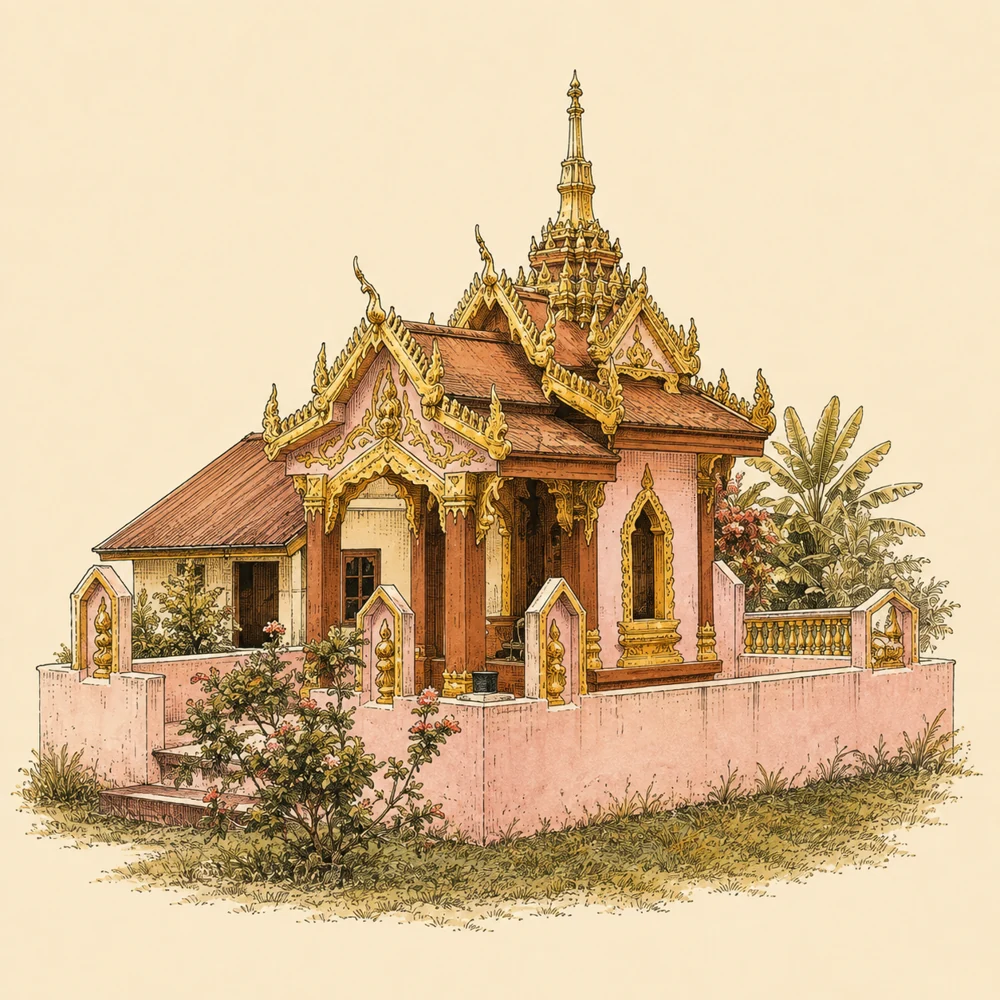
ThenA small ordination hall on Khuan Tham in the mining era of Takua Pa
1970 (2513 BE)
VerifiedThe clearest evidence specifying a construction year at this time is for the temple's small ordination hall, built in 1970 (2513 BE) by Mrs. Huatbi. As for the year the entire temple complex began construction and the reason for choosing the site, there are no confirming documents yet. Therefore, one should not recount history beyond the available evidence.
This temple emerged during the late era when Takua Pa still had shared memories with tin mining. The town has roots as a port community with trade exchanges among people of many nationalities. Later, the tin mining economy and the Chinese community played a significant role. However, no evidence has yet been found that the builders of the ordination hall or Wat Khuan Tham were directly connected to the governor, the mines, or the Hokkien Chinese group.
What can be seen of the site's role is its function as a community religious site, with the ordination hall serving as a center for rituals and local art. Inside is a bas-relief stone Buddha image, behind it is a character inscription, and the boundary markers (sema) around the ordination hall are shaped as Buddha images in various postures.
BeforeFrom a religious site to a deserted temple list: A transition with gaps
After 1970 (2513 BE) · Before 2026 (2569 BE) (no yearly event periods found)
VerifiedOfficial data from the Samnakngan Nayobai Lae Phaen Sapphayakon Thammachat Lae Singwaetlom (Office of Natural Resources and Environmental Policy and Planning) classifies Wat Khuha Phimuk (Wat Khuan Tham) in the 'temple, abandoned temple, religious site' category. Meanwhile, the central religious property register of the Samnakngan Phraphutthasatsana Haeng Chat (National Office of Buddhism) lists 'Wat Khuan Tham (abandoned)' in Takua Pa district. Thus, it can only be confirmed that the temple is recorded as abandoned in government databases; it is unknown when it became abandoned or for what reason.
Takua Pa town itself transitioned from a port and mining town. As tin mining operations gradually ceased, economic liveliness decreased, and the old town shifted to being valued as a community heritage. This context helps explain the backdrop of the town's transition, but there is still no direct evidence linking Wat Khuan Tham to the impact of the mine closures.
No evidence has been found verifying any specific year of restoration, change of ownership, other uses, the 2004 (B.E. 2547) tsunami event, or a specific historical site registration announcement by Krom Sinlapakon (Fine Arts Department) for this temple.
NowPresent day: An art site with a tiny ordination hall, but its operational status is unclear
2569 / 2026
VerifiedIn 2026 (B.E. 2569), discovered official sources still record this place as an "abandoned temple" and do not provide opening hours, admission fees, caretakers, or contact channels. Therefore, it cannot be verified whether the temple is open to visitors or if monks reside there.
A verified highlight is the very small ordination hall, which ONEP identifies as the smallest in Thailand. Inside, there is a low-relief carved stone Buddha image with an inscription on the back, and an ancient hermit statue in the front.
No news or public announcements have been found verifying restoration projects, developments, traditional activities, or community use of the area over the past 5 years. Therefore, the current condition of the building and regular activities should be checked with locals or area caretakers before being published as travel information.