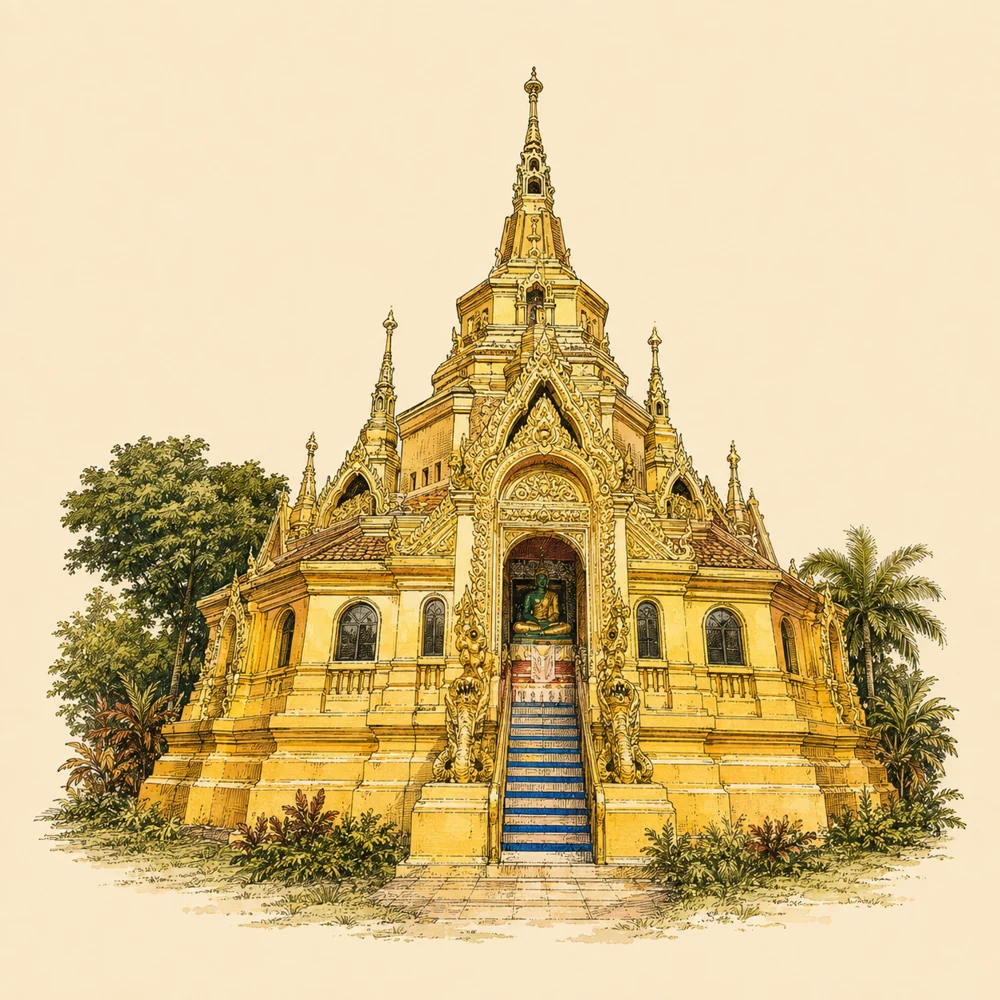
ThenA riverside temple of Takua Pa, starting under the name 'Wat Kongkha'
1762 (B.E. 2305) (proposed by local and government sources); 1936 (B.E. 2479) (ordination hall)
Conflicting informationEvidence from the environmental art agency states the temple was built in 1762 (B.E. 2305) and originally named Wat “Kongkha”, while the archaeological database of Sun Manutsayawitthaya Sirindhorn (Princess Maha Chakri Sirindhorn Anthropology Centre) indicates the age of the important historical site based on the ordination hall built in 1936 (B.E. 2479). The origin should therefore be read as a two-layer history: the temple's age according to registration or accounts, and the age of the surviving buildings, which are not the same.
The temple is located on an alluvial plain along Khlong Takua Pa, on the west side of the waterway, in a town with a history as a coastal city and a centre for tin mining and maritime trade. This urban context suggests the temple likely served as a religious site for the riverside community. However, no specific evidence for the temple has been found identifying the founder, the reason for construction, or the direct role of Hokkien Chinese or the town governor. Therefore, details beyond the evidence should not be added.
The ordination hall, built in 1936 (B.E. 2479), is a southern-style brick-and-mortar building facing east, decorated with stucco depicting pagodas, Buddha images, Dharma wheels, and flora. This reflects its role as both a space for religious ceremonies and a showcase of community craftsmanship from the late Rattanakosin period to the reign of King Rama VIII.
BeforeA new name, a new historical site, and returning as a living temple
1940 (B.E. 2483); 1996 (B.E. 2539); 2002 (B.E. 2545)
VerifiedThe temple history recorded in the archaeological database states that it was originally called Wat Kongkha before being changed to Wat Kongkha Phimuk in 1940 (B.E. 2483). Meanwhile, the ordination hall and pagoda are still in use and have not become ruins isolated from the temple. The different names in documents should be preserved to show readers the site's development.
Krom Sinlapakon (Fine Arts Department) announced the registration of the ordination hall and pagoda, along with designating the historical site boundaries, in the Royal Gazette on 18 December 1996 (B.E. 2539). The registration ensures the heritage value of the old buildings is protected as an artistic legacy. Concurrently, it remains a private temple affiliated with the Maha Nikaya sect, with resident monks.
The provincial dharma practice centre registry of Samnakngan Phraphutthasatsana Haeng Chat (National Office of Buddhism) lists “Kongkha Phimuk” as the 1st dharma practice centre of Phang Nga province according to a 2002 (B.E. 2545) resolution. Currently, the archaeological database indicates that it is maintained and generally in stable condition. However, no evidence has been found verifying if the area was affected by the 2004 (B.E. 2547) tsunami or if it had a specific period of abandonment or restoration.
NowA historical site that still breathes: An active temple and meditation center
2569 / 2026
VerifiedIn the latest published information, Wat Kongkha Phimuk still has resident monks and operates as a private temple affiliated with the Maha Nikaya sect. The maintaining agency is stated to be the temple itself, with the archaeological database advising to contact Phra Khru Nanthapanyakon, the abbot, at 076-421-479.
The ordination hall and pagoda are active historical sites. The temple interior is described as clean, shady, and suitable for religious practices. The temple also serves as the 1st provincial dharma practice centre of Phang Nga, making it a place where people can pay respects to Buddha, admire the stucco work, and engage in dharma practice.
Activities with cited sources include dharma practice in honour of the monarchy, overnight New Year prayers, Brahmin nun ordination for royal merit, and summer novice ordination. However, no 2026 (B.E. 2569) announcements have been found verifying activity schedules, opening hours, new restoration projects, or facility details. Therefore, you should call the temple before travelling.