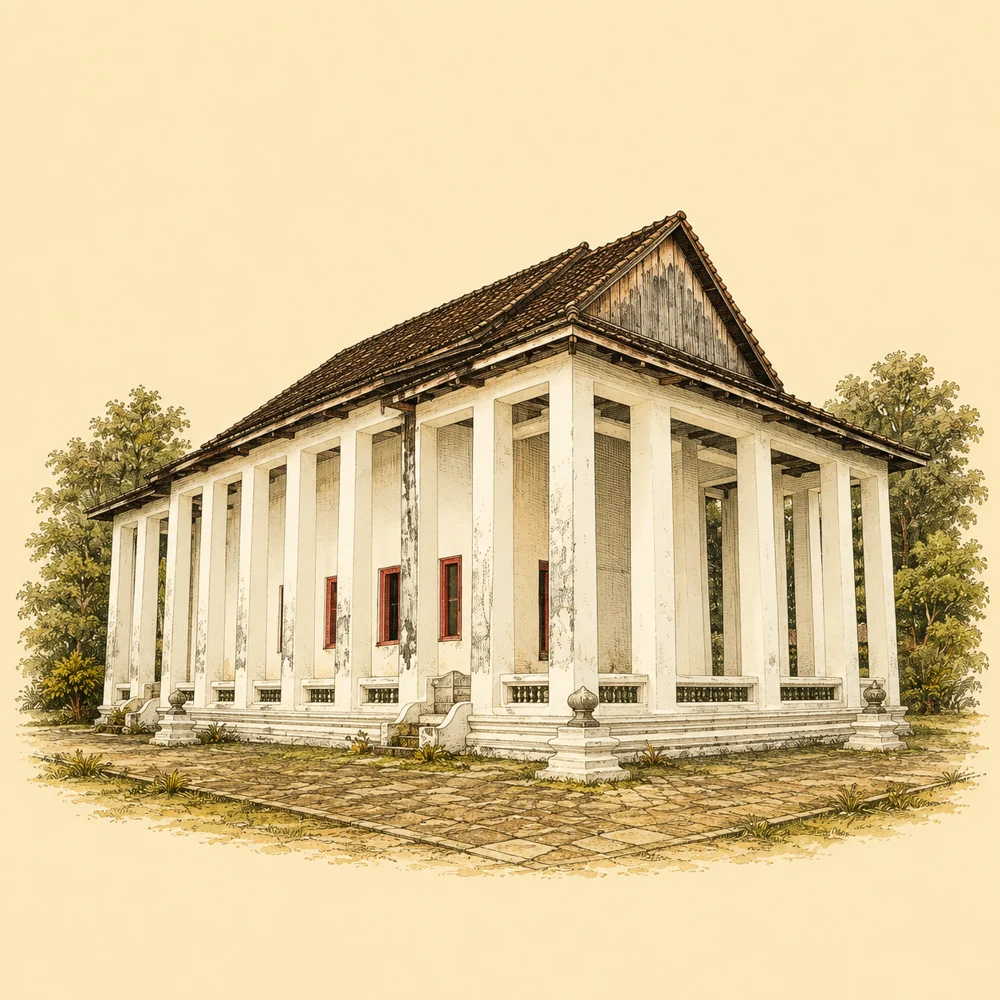
ThenWat Mai Kamphaeng: The governor's temple in the mining town
Around 1847 (2390 BE)
VerifiedWat Senanucharangsan, or locally called “Wat Mai Kamphaeng”, emerged during the period when Phraya Senanuchit (Nuch na Nakhon) was the governor of Takua Pa. Sources from the Princess Maha Chakri Sirindhorn Anthropology Centre state that the temple was built after the town walls, government offices, and the governor's residence were completed. Thus, it is significant as both a Buddhist offering and a memorial to its builder.
The original area was a mound at the foot of Khao Chamonkhiri. Phraya Senanuchit had the area leveled, then built a brick and mortar wall about 2 meters high, with east and west gates, before constructing an ordination hall in the middle of the temple and two preaching halls on the sides. The name “Wat Mai Kamphaeng” (New Walled Temple) was therefore not just a name for a new temple, but reflected the town landscape taking shape along with administrative power and a community center.
In the era when Takua Pa was still an Andaman port town, connecting maritime trade and the tin economy, the temple's ordination hall was used as the site for the oath of allegiance ceremony. This shows that the temple directly connected religious rituals with the town's political order. Meanwhile, the ordination hall's style, which received Chinese influence, also aligned with the market district and Takua Pa's Hokkien Chinese community, but sources do not confirm that the craftsmen or patrons were directly Chinese.
BeforeFrom a ceremonial temple to old town heritage: Repairs, changes, and registration
1865·2023 (2408·2566 BE)
VerifiedThe temple continued to be the site for the oath of allegiance ceremony in the period before the 1932 (2475 BE) revolution. Meanwhile, the temple's history records Phra Khru Udom Panya (Nuam) as the abbot between 1865·1909 (2408·2452 BE), and disciples later built a stupa containing his relics around 2014 (2557 BE). This gives the temple layers of memory of both the town and the local monastic community.
The buildings do not entirely retain their original forms. The Encyclopedia of Thai Culture states that the ordination hall once had a three-tiered roof covered with scaled tiles, but it was repaired by reducing it to a single tier and replacing it with corrugated iron. Another set of temple registry data indicates that the current preaching hall was built in 1963 (2506 BE) and lists the date of receiving royal boundary consecration (Visungkhamasima) as 8 January 1898 (2440 BE). However, some year details in secondary sources have typing or scanning errors, so they are not used as evidence to confirm additional restoration years.
Krom Sinlapakon (Fine Arts Department) registered the temple's ancient monument status in 1996 (2539 BE), with the highlights being the wall around the temple and the large ordination hall with Chinese influence. Later, in the context of the Takua Pa old town revival, the temple is also home to the Takua Pa Community Museum, which collects utensils and equipment from the mining way of life. This makes the temple area function as both a religious site and a space recounting the town's memories after the mining era.
NowAn active historical site, but access must be checked locally
2569 / 2026
VerifiedThe latest accessible evidence confirms that Wat Senanucharangsan is still presented as a learning center and tourist attraction of Takua Pa old town. Tesaban Mueang Takua Pa (Takua Pa Town Municipality) has media introducing the temple, and in 2023 (2566 BE) published the candle procession and town circumambulation activities along with an offering ceremony to request permission to restore the ordination hall.
Inside the area, there are important elements to observe, namely the ordination hall, the brick wall around the temple, the stupa containing the relics of Phra Khru Udom Panya, and the Takua Pa Community Museum. Academic work indicates that the museum stores utensils and equipment from the mining era, allowing a visit to the temple to connect with the labor history, trade, and daily life of the town.
However, no official announcements have been found in 2026 (2569 BE) that confirm the name of the current caretaker, opening hours, areas open for visits, the condition of restoration results after the 2023 (2566 BE) ceremony, or regular temple activities. Therefore, the visiting status should be considered "must check before traveling" and it should not be concluded that the museum or ordination hall is open daily based solely on online information.